

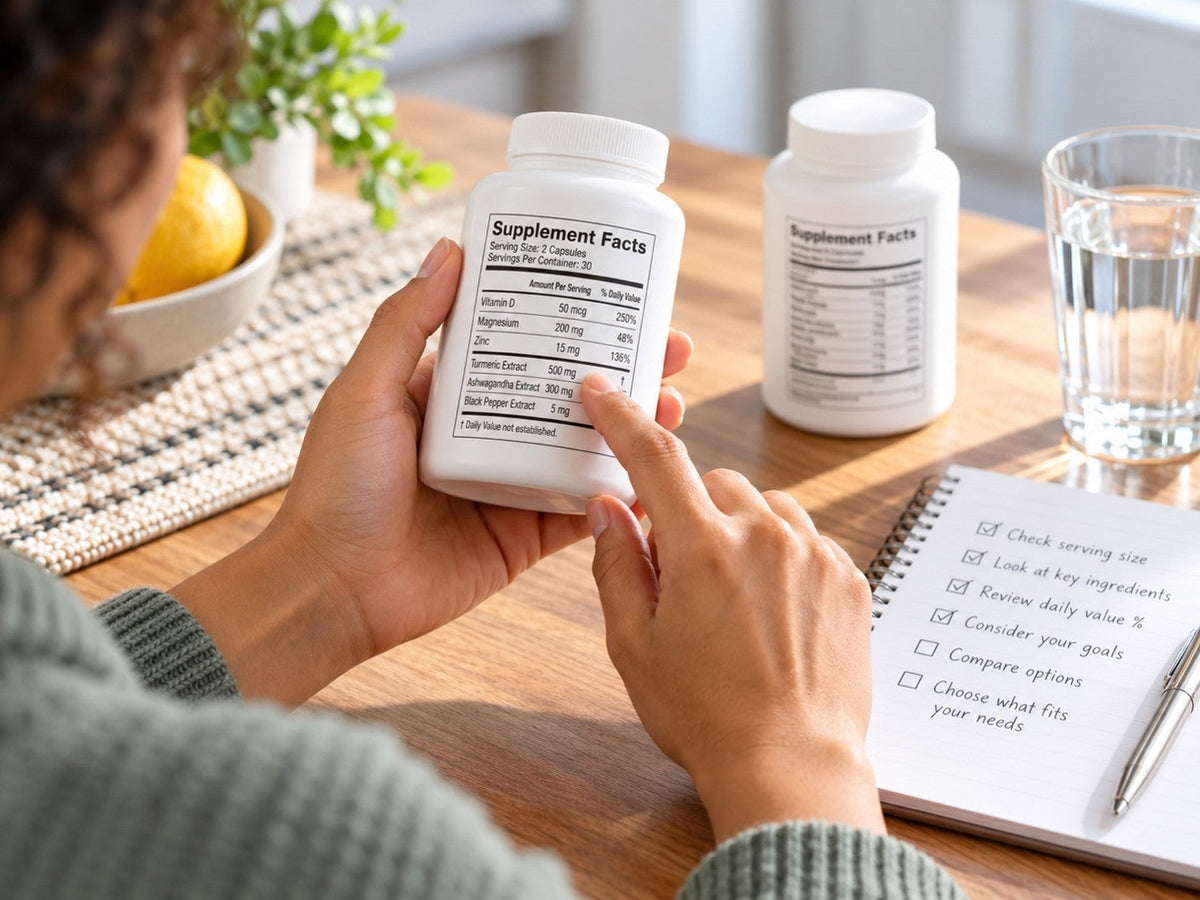
Pick up a bottle of vitamins or a dietary supplement and look at the front.
You'll probably see familiar phrases: premium ingredients, advanced formula, daily wellness support, and more.
Turn the package around, however, and things become a little more complicated.
Percentages. Ingredient names. Serving sizes. Daily Values. Warnings in small print.
It's enough to make you wonder whether you're supposed to have a science degree just to choose a multivitamin.
You don't.
But knowing how to read a supplement label can help you make a more informed decision.
Here are five things worth checking before you purchase your next dietary supplement.

1. Start With the Serving Size
Before you get impressed by an ingredient list, find out how much of the product you're supposed to take.
Is one serving a capsule? Two tablets? A tablespoon? One drink packet?
This matters because the quantities listed in the Supplement Facts panel generally refer to a specific serving.
A product that appears to contain an impressive number of nutrients might require several capsules or another defined quantity to provide those amounts.
Always check the suggested serving size and directions.
And remember, taking more than the recommended amount does not necessarily produce better results.
2. Look at the Amounts, Not Just the Ingredients
Seeing a familiar vitamin listed on the front of a package doesn't tell you how much it contains.
The Supplement Facts panel provides more useful information.
Look for the amount per serving and, where applicable, the percentage of Daily Value.
Daily Value percentages help you understand how much a serving contributes to a recommended daily intake.
They aren't a personalized prescription for your specific nutritional needs, but they're a useful comparison tool.
This is especially helpful when comparing products that contain some of the same vitamins or minerals.

3. Check the Other Ingredients
The largest words on the front of the package don't always tell the whole story.
Take time to read the full ingredient information.
You may find sweeteners, flavorings, botanical ingredients, or substances you didn't expect.
Some ingredients may be perfectly appropriate for your preferences. Others might be things you're trying to avoid.
If you have allergies, dietary restrictions, or particular ingredient concerns, this step becomes especially important.
The right product for someone else isn't automatically the right product for you.
4. Read the Directions and Warnings
Supplements are often marketed as everyday wellness products, but that doesn't mean they're appropriate for everyone.
Some ingredients can interact with medications. Certain products may not be suitable during pregnancy or nursing. Others have specific age restrictions or usage recommendations.
Pay attention to these details.
If you're taking medication, managing a medical condition, or are unsure whether a product is appropriate, speak with your healthcare professional before starting it.
Being informed is part of taking care of yourself.

5. Understand What a Label Can't Promise
There's a difference between supporting normal health and treating a medical condition.
Dietary supplements are not medicines, and the FDA does not approve dietary supplements for effectiveness before they go on the market.
Be cautious of products that promise dramatic results, guaranteed outcomes, or cures.
A supplement may have a place in your routine, but it cannot replace a varied diet, regular physical activity, adequate rest, or necessary medical care.
An Example: Reading the NutraBurst® Label
Let's apply these ideas to one of TLC's familiar products.
NutraBurst® is a liquid multivitamin that provides a variety of nutrients, including vitamins A, C, D, E, and several B vitamins.
The product comes in convenient formats, including individual Rip & Sip gel packets.
Rather than relying only on the front-of-package description, look at the Supplement Facts panel to understand the specific nutrients and quantities.
Review the adult serving directions, ingredients, and warnings.
Then consider the more important question:
Does this product make sense for my current nutritional needs and daily routine?
That's the decision that matters.
Confidence Comes From Understanding What You're Buying
A great wellness routine shouldn't depend on guesswork.
The next time you're considering a supplement, look beyond the headline promises.
Read the label. Understand the serving size. Check the ingredients. Ask questions.
And choose products based on what you actually need—not simply what's getting attention online.


发表评论
此站点受 hCaptcha 保护,并且 hCaptcha 隐私政策和服务条款适用。